
Custom Ceremony Writing: Location & Logistics Guide
Table of Contents
Why Ceremony Logistics Shape a Custom Ceremony
Choosing a Ceremony Location That Fits Your Script
Venue Suitability and Site Visit Checklist
Accessibility and Inclusive Guest Logistics
How Long Should a Wedding Ceremony Be?
Building a Personalized Wedding Ceremony Script
A Simple Custom Ceremony Writing Workflow
Outdoor Wedding Ceremony Logistics: Sound, Weather, and Setup
Mapping Your Wedding Ceremony Timeline and Run-of-Show
Sample Ceremony Run-of-Show (30-Minute Ceremony)
Photography Beats to Build Into the Timeline
Rehearsal Cues That Belong on the Run-of-Show
Contingency Planning and Legal Details Before the Big Day
A One-Page Contingency Plan
Backup Equipment and Script Shortening
Legal and Administrative Requirements to Confirm
Frequently Asked Questions
Last Updated: October 17, 2026
Why Ceremony Logistics Shape a Custom Ceremony
Great ceremony logistics are the invisible architecture of a custom ceremony: the words only land when space, sound, seating, and timing support them.
At Coastal Vows By Mike, ceremony logistics are the practical planning behind a personalized ceremony: venue suitability, run-of-show timing, sound, accessibility, and backup plans.
Below, we'll show you how to plan location and ceremony logistics around a custom ceremony script so the words and setting work together, using the same checklists and run-of-show template we use when reviewing a site.
Choosing a Ceremony Location That Fits Your Script
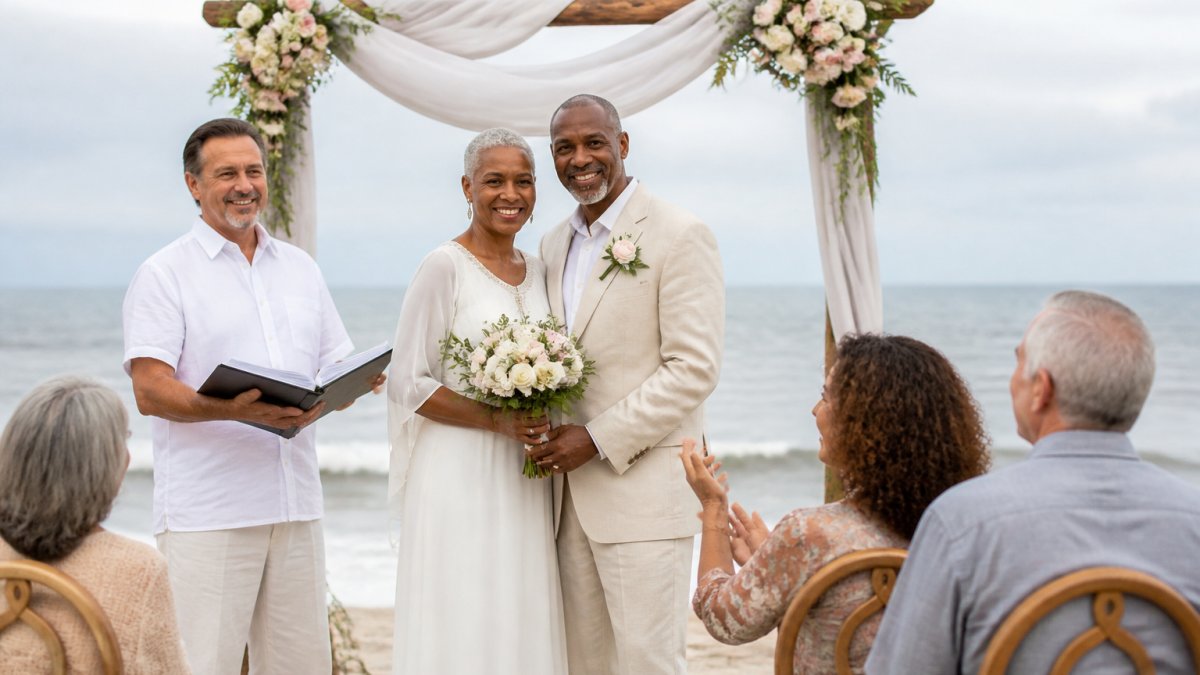
The right ceremony location supports the tone of your script, not just the prettiest backdrop. A formal, vow-heavy ceremony needs a space where guests hear every word; a short, playful ceremony can work almost anywhere.
Match script length and tone to the venue's conditions. Open shoreline sites carry constant wind and noise, favoring shorter spoken sections and a strong microphone setup; enclosed gardens hold sound better and suit longer readings.
Venue Suitability and Site Visit Checklist
A site visit answers questions no brochure can. Walk the space at your ceremony hour and check:
Ceremony start and end window confirmed in writing
Wind, traffic, and ambient noise levels at ceremony hour
Power access or battery plan for sound equipment
According to American Marriage Ministries' officiant preparation guidance, confirming date, venue, travel, and attire early prevents most day-of surprises. We treat that checklist as the floor, not the ceiling.
Accessibility and Inclusive Guest Logistics
Accessibility planning belongs in the script stage, not the week before. Note which guests use wheelchairs or walkers or need reserved front seating, and confirm a firm, level path from drop-off to seating.
Confirm accessible restrooms and a smooth ceremony surface, for beachfront settings, often a walkway or mat over sand. Build extra processional time for guests who need it, and brief your photographer on seating so no one is blocked.
Pro Tip Walk the full guest route yourself, from parking to seat, in the shoes you'll wear that day. Sand, gravel, and sloped paths feel very different in heels or with limited mobility, and this is the single fastest way to catch a problem.
How Long Should a Wedding Ceremony Be?
Most wedding ceremonies run 20 to 30 minutes, enough for a personal story, vows, a ritual, and a pronouncement without testing guest attention. Shorter civil-style ceremonies often finish in 10 to 15 minutes.
Length should follow content, not convention. A personalized wedding ceremony script with a full love story, two readings, and a unity ritual needs closer to 30 minutes; a simple vow exchange with one reading fits in 15.
Build the estimate element by element rather than guessing at a total:
Ceremony Element | Typical Duration |
Processional | 3-5 minutes |
Welcome and opening | 2-3 minutes |
Love story or remarks | 4-6 minutes |
Readings | 3-5 minutes |
Vows and rings | 5-7 minutes |
Unity ritual | 3-5 minutes |
Pronouncement and recessional | 3-4 minutes |
Add the rows up and you have a realistic ceremony length before you write. If the total runs long, cut a reading rather than rushing the vows.
Building a Personalized Wedding Ceremony Script
A personalized wedding ceremony script is a written order of events with custom language for the welcome, remarks, vows, and rituals. The structure stays familiar to guests; the words carry your story.
The most common mistake is writing beautiful language with no plan for who speaks it, when, and into what microphone. Write the script and logistics side by side, and ask your officiant how much of your wording they'll incorporate.
A Simple Custom Ceremony Writing Workflow
Follow this sequence to keep script and logistics in sync:
Confirm the venue and ceremony window. Everything else fits inside these limits.
Complete a story questionnaire. Capture how you met, key moments, and what you value as a couple.
Draft the order of events. List every element and who leads it.
Write the custom sections. Welcome, remarks, vows, and ritual language.
Time a full read-through aloud. Add 20 percent for pauses and laughter.
Mark logistics cues in the margin. Microphone handoffs, music starts, seating moves.
Rehearse with the actual participants. Confirm entrances, exits, and cue words.
That sixth step is where most scripts fail. A line that reads beautifully can be impossible to deliver if the officiant is handing off a microphone mid-sentence.
Outdoor Wedding Ceremony Logistics: Sound, Weather, and Setup
Outdoor wedding ceremony logistics come down to three variables: sound, weather, and setup time. Get those right and an outdoor ceremony feels effortless.

Sound is the most common failure.
Weather planning means a documented decision point: agree in advance on the wind threshold for loose decor, the rain call time, and who has authority to move guests to the backup space.
Watch Out Skipping the sound check at the actual ceremony hour is the mistake that ruins the most outdoor ceremonies. Wind and background noise at 4 p.m. sound nothing like the quiet morning you tested in, and guests at the back will miss the vows entirely.
Mapping Your Wedding Ceremony Timeline and Run-of-Show
A wedding ceremony timeline is the minute-by-minute schedule telling every participant what happens, when, and who is responsible. It's the single document your photographer, musicians, venue coordinator, and officiant all work from, the difference between a calm ceremony and an improvised one.
Build the run-of-show backward from the ceremony start time. Give every element a clock time, an owner, and a trigger cue, then produce two versions: a full one for vendors and a one-page one for family and wedding party.
Sample Ceremony Run-of-Show (30-Minute Ceremony)
The timeline below assumes a 4:00 p.m. start, a 30-minute ceremony, and a 15-minute guest arrival window. Adjust the clock times to your start, but keep the durations and ownership column, those make the document usable.
Clock Time | Duration | Element | Lead | Cue / Notes |
3:30 | 15 min | Vendor and family arrival, sound check | Officiant + sound lead | Test both microphones at ceremony volume |
3:45 | 15 min | Guest arrival and seating | Venue staff / ushers | Pre-ceremony music begins; reserved rows marked |
3:55 | 5 min | Wedding party lines up | Coordinator | Processional order confirmed; bouquets distributed |
4:00 | 3-5 min | Processional | Coordinator cues musicians | Officiant enters last; microphone on |
4:05 | 2-3 min | Welcome and opening | Officiant | Confirm guests can hear before continuing |
4:08 | 4-6 min | Love story or remarks | Officiant | Pause for laughter; keep pace |
4:14 | 3-5 min | Reading(s) | Reader(s) | Second microphone handoff; reader steps to marked spot |
4:19 | 5-7 min | Vows and rings | Couple | Rings with best man or ring bearer; vow cards in hand |
4:26 | 3-5 min | Unity ritual or symbolic element | Couple | Table preset; supplies within arm's reach |
4:31 | 1-2 min | Pronouncement and kiss | Officiant | Photographer positioned center aisle |
4:33 | 3-4 min | Recessional | Couple + wedding party | Music change cue; guests dismissed row by row |
4:37 | 15-20 min | Post-ceremony photos / receiving line | Photographer | Family shot list handed over in advance |
Add the durations and you have a realistic ceremony length before writing a line of script. If the total runs long, cut a reading or shorten remarks rather than rushing the vows, vows are what guests remember.
Photography Beats to Build Into the Timeline
A run-of-show that ignores the photographer produces missed shots. Build these beats in and confirm them during the site walk:
Pre-ceremony: detail shots of rings, license, vow books, and program 30-45 minutes before guests arrive.
Processional: photographer positioned at the front, second shooter at the back for the couple's entrance.
Vows: clear sightline to both faces; confirm the officiant will step aside rather than stand between the couple and the camera.
Rehearsal Cues That Belong on the Run-of-Show
Hold a short rehearsal against this document, even for a small ceremony. Walk the processional once with the real cue words and music start, practice the microphone handoff for readings, and confirm where the rings and license will be. For intimate ceremonies, a condensed 20-minute rehearsal covering entrances, the handoff, and the recessional is usually enough.
Pro Tip Print the vendor version of the run-of-show and tape a copy inside the officiant's binder. When timing slips, and it usually does by a few minutes, the officiant can see the next cue without breaking the ceremony to ask.
Contingency Planning and Legal Details Before the Big Day
Contingency planning means deciding in advance what you'll do if weather, sound, timing, or a vendor fails, and who has authority to make each call. Legal details mean confirming the paperwork is valid before anyone walks down the aisle. Both belong on the same one-page document, because both are what couples most often leave to the morning of the ceremony.
A One-Page Contingency Plan
Write this plan at least two weeks out and share it with the officiant, venue coordinator, and photographer. Each line needs a trigger, a decision-maker, and an action, not just a topic.
Risk | Trigger / Decision Deadline | Decision-Maker | Action |
Rain | Call by 2 hours before start | Couple + venue coordinator | Move guests to backup space; officiant and sound lead relocate microphones |
High wind | Sustained wind that moves decor or overwhelms microphones | Officiant + venue coordinator | Remove loose decor; switch to windscreened microphones; shorten outdoor remarks |
Heat | Forecast above the venue's comfort threshold | Couple | Add shade, water station, and fans; shorten pre-ceremony outdoor time |
Late start | 10 minutes past scheduled start | Coordinator | Begin processional with shortened welcome; cut optional reading |
Sound failure | No audio at sound check or mid-ceremony | Sound lead | Swap to backup battery-powered speaker and handheld microphone |
Missing vendor | No arrival 30 minutes before call time | Coordinator | Call vendor; activate backup contact from vendor list |
Keep a physical copy with the officiant and a digital copy with the coordinator. The point isn't predicting every problem, it's removing the on-the-spot negotiation that turns a small delay into a visible disruption.
Backup Equipment and Script Shortening
Build a small contingency kit: a charged spare battery per microphone, a backup battery-powered speaker, printed full and one-page shortened scripts, and a folder with the marriage license, rings, and vendor contact list. Decide in advance which elements get cut if the ceremony starts late, typically an optional reading or second symbolic ritual, so the vows and pronouncement are never rushed.
Legal and Administrative Requirements to Confirm
Marriage license rules are set by state and county, and the details affecting your ceremony plan vary widely: waiting periods, expiration windows, who may officiate, whether witnesses are required, and where the license must be returned. Confirm the rules directly with the county issuing your license rather than a general guide, and confirm your officiant's authorization to sign in that jurisdiction.
Build these legal checkpoints into the run-of-show:
License in hand before the ceremony. Confirm the issuing county's waiting period and expiration window so the license is valid on the ceremony date.
Officiant eligibility confirmed. Verify the officiant is authorized to solemnize and sign in the jurisdiction where the ceremony takes place.
Witnesses identified. If witnesses are required, name them in the run-of-show and seat them near the signing location.
Watch Out The most common legal snag is a license that expires before the ceremony or an officiant whose authorization does not cover the ceremony's jurisdiction. Confirm both at least 30 days out, not the week of, because resolving either problem takes longer than most couples expect.
Key Takeaway The couples who stay relaxed are the ones who decided in advance who makes the weather call, what gets cut if time runs short, and who holds the license at the signing. Decide once, in writing, and the day itself gets simpler.
Frequently Asked Questions
How do you choose the right location for a wedding ceremony?
Start with the guest experience: seating capacity, shade, parking, and a short walk from where guests arrive. Visit the site at the same time of day as your ceremony so you can check sun angle, noise, and foot traffic. Confirm whether the venue allows amplified sound, chairs, and an arch, and ask about a rain backup. A location that looks beautiful in photos but has no shade, no accessible path, or tight vendor access will complicate your ceremony logistics on the day.
How long should a wedding ceremony be?
Most ceremonies run 20 to 30 minutes, which gives enough room for a processional, welcome, readings, vows, a unity ritual, and the recessional without losing the room. A simple civil-style signing can take 10 to 15 minutes. If you are adding a handfasting, unity sand, or a longer reading, plan for 30 to 40 minutes and cut something else. The right length is the one that keeps guests engaged and still feels complete to you.
How do you make a wedding ceremony feel personal without making it too long?
Pick two or three personal elements and do them well rather than stacking every idea. A short love story told by the officiant, handwritten vows, and one symbolic ritual are usually enough. Keep each piece tight: a two-minute story, vows under two minutes each, and a ritual that takes three to five minutes. Personal touches land harder when the ceremony has room to breathe, and a well-paced 25-minute ceremony feels more intimate than a 45-minute one that drags.
What logistics should you consider when planning an outdoor wedding ceremony?
Outdoor wedding ceremony logistics come down to sound, weather, and access. Test a microphone and speaker before guests arrive, since open air swallows voices. Have a rain plan with a covered backup and a decision deadline, usually two to three hours before start time. Confirm power sources, chair delivery and pickup windows, and a level spot for the arch. Also check the tide schedule if you are on the sand, and tell guests about footwear and walking distance in advance.
How do you plan a wedding ceremony timeline?
Work backward from the ceremony start time. Give the officiant and couple 15 minutes to arrive and settle, vendors 60 to 90 minutes to set up chairs and sound, and the processional a fixed cue. Build a run-of-show that lists each element with a duration: processional, welcome, readings, vows, ritual, pronouncement, recessional. Add a 10-minute buffer before the ceremony and share the document with your photographer, DJ, and venue contact so everyone works from the same schedule.
How can you personalize a wedding ceremony script?
A personalized wedding ceremony script starts with a questionnaire or planning call that captures how you met, what you value, and the tone you want. From there, the officiant drafts language in your voice, then you review and adjust it. Include specific details, a shared inside joke used sparingly, and names of family members you want acknowledged. Read the draft aloud together to catch anything that sounds stiff, and keep the final script in a binder the officiant brings on the day.
Check Your Date
Comments